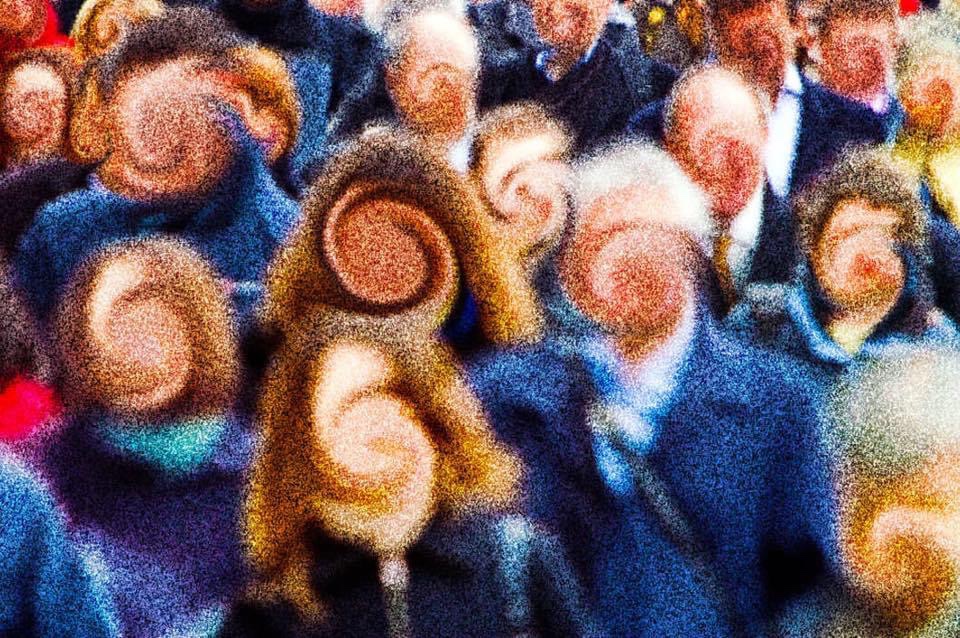
Prosopagnosia is a neuropsychological condition that impairs the sufferer’s ability to recognize faces. It’s also known as face-blindness, and those who are afflicted lack a skill that comes naturally to most humans, forcing them to find ways to work around this deficit. Oliver Sacks, the face-blind neurologist, relied on distinguishing features like flaming red hair or heavy glasses to identify his best school friends, but he still had difficulties: Once, he ignored his own psychiatrist when he saw him in the lobby shortly after their session (as he wrote in the New Yorker, his assistant would instruct their dinner-party guests to wear name tags).
The artist Chuck Close managed his condition through his work — after photographing his larger-than-life portraits, he could remember the person attached to the face: “Once I change the face into a two-dimensional object, I can commit it to memory,” he once told a newspaper. Face-blindness is generally accompanied by a raft of problems, including a lack of interest in people, social anxiety, inattentiveness, and various phobias (Sacks avoided conferences or large gatherings).
According to the National Institutes of Health, face-blindness “is thought to be the result of abnormalities, damage, or impairment in the right fusiform gyrus, a fold in the brain that appears to coordinate the neural systems that control facial perception and memory.” At the moment, there aren’t any treatments that are known to be effective — management of the condition, the NIH notes, should focus on “develop[ing] compensatory strategies.”
While the condition has been reported in medical literature since the 19th century, it wasn’t until the mid-1930s that researchers suggested facial recognition involves processes that differ from other forms of visual recognition. For most of the time it’s been recognized by modern medicine, the majority of documented cases occurred following head trauma or stroke. But over the last decade or so, as more academics have begun studying face-blindness and as public awareness of it has spread, those with so-called developmental prosopagnosia — that is, those who were born with it — have grown more likely to come forward to seek diagnoses. Nevertheless, while this condition affects about 2 percent of the population, many who have it may still be totally unaware they do.
In 2002, Drs. Brad Duchaine and Ken Nakayama, professors at Dartmouth and Harvard, started the website faceblind.org, which encourages people to come forward for assessment and testing. Duchaine notes that about two thirds of the over 10,000 subjects who have been tested are women, but speculates this might be because they are more willing to admit to this weakness and seek help. One of Duchaine and Nakayams’s key observations is that although many sufferers know something is wrong, they attribute the symptoms to anxiety or some other inexplicable social defect. Some report enjoying professions in which they don’t have to interact with many people, but Dr. Duchaine has heard horror stories from those who ended up in the most unsuitable of professions (teaching at a large school or working as a security guard, for example). It’s unknown if developmental prosopagnosia is congenital or if the defect is acquired in infancy.
Science of Us spoke with a 47-year-old consultant, writer, and part-time EMT from New England who has developmental prosopagnosia.
Have you always known you have prosopagnosia? No. I only discovered it when I was in my late 30s, after I read an article in the New York Times. I thought I was uniquely stupid when it came to distinguishing or recognizing faces, but I couldn’t believe it when I discovered this was an actual condition. I told my mother to read the story. She got my two brothers to read it and one of them said, Oh gosh — that’s me too. That’s how we found out that we all share this trait.
What problems does it cause? The issue is how I remember faces. It doesn’t matter if I know the person: I’ve walked right past my husband, my own mother, my daughter, my son, without being able to recognize them.
It can be very embarrassing, and it can offend people. I once had to drop a sociology class, because I told the professor, to her face, that she was a horrible lecturer. I thought I was complaining to a fellow student! It’s as if I have a missing chip — you feel like you’re just not trying hard enough. Faces are so important to humans that we have a special part of our brain dedicated to recognizing them. Most people remember them as a whole piece, but I don’t.
How do you remember them? Say I showed you a bowl of fruit for 20 seconds. You would remember it as a bowl of fruit. If I let some time pass and asked you to tell me where the apple, pears, and bananas were positioned, you probably wouldn’t be able to. You would have to stare at that bowl of fruit, and commit it to memory, and you would have to know that you had to commit it to memory when you were looking at it.
To tell people apart I have to find a distinguishing feature. And context is huge. If I’m expecting to see somebody, I’ll figure out who they are by observing their body language, listening to their voice. Good-looking people are the most difficult to recognize
Is that because their faces are symmetrical? Yes! Straight teeth, noses within regular limits … everything is so … normal! It’s like a flock of chickens. So what I do is look for specific features. I have one friend who’s average height, middle aged, and white, and she works in an office full of average middle-aged white ladies. And even worse, it’s a doctor’s office, so they are all wearing scrubs. If I meet her at work, I can only recognize her if she smiles — it’s very specific. But these are the things I look for: Some people have a distinctive nose; some people have two different-colored eyes.
What did you do after reading the article? Did you get formally diagnosed? It gave me a keyword that I could actually Google, and I found a group from Dartmouth that was researching face-blindness. They had an online test for self-diagnosis, and after I took it, I had a phone interview and then some in-depth visual tests. They show you pictures of celebrities but maybe you just don’t know who these celebrities are, so they first establish whether you’re from another country, English is your second language, maybe you grew up without a TV, maybe you live under a rock — that kind of thing.
The researchers concluded that I’m profoundly face-blind. One thing I find very difficult to get across is that it’s not as if I can’t recognize anybody at all — it’s that it can take me up to five minutes before I can figure out who they are. I have to wait for the signs. The other thing I have discovered is that there is a specific expression people have when they see somebody they know.
What’s that? I call it the “I know you face” — it’s sort of a surprised micro expression. I’m convinced that it’s completely involuntary. It looks a little like surprise. The eyebrows go up, and usually the mouth opens like they’re about to say something. When I see it, I say hello, and then when I start interacting with them, I’ll remember who they are. That’s just one of a whole set of observational skills I’ve developed. Another is when I’m meeting somebody in public, I’ll arrive early so they’ll approach me.
I’m always looking for visual hooks. My daughter has a particular thing she does with her mouth. If there’s several people who could be her, I look for the mouth thing. If she’s nervous, or she’s irritated, one side of her mouth goes up. She’s done it since she was a baby. She doesn’t like having her photograph taken, so when I look at a group photo, I look for the kid with the smirk and I know it’s my daughter.
Does that mean that those kinds of things annoy you? Are you easily irritated if someone does something weird with their face or, say, cracks their knuckles? No, any developmental weirdness is great for me. I was always friends with the weirdest kid I could find. I love people with tattoos, piercings, or unusual hairstyles. I can relax around them because they are easy to recognize. I tend to feel very warm toward people who are not considered attractive because I know who they are — wonky teeth, things like that. I have several trans friends. Physical ambiguity might put someone else off but not me. And the same goes for if someone has a disability, like a limp or a missing limb. A face covered in freckles or unsightly scars are great visual hooks for me. If I were to witness a crime, I’d be a better help to police if the suspect had their face covered. I could tell you what he was wearing and minute details, like that he’d just taken off his wedding ring because he had a tan mark on his hand.
Your mother has it, right? Do you know if it runs in the family? We think my mother’s father had it because when they walked to church, he’d tip his hat to every single person he saw. When she’d ask him who it was, he’d say, “ I have no idea.” Interestingly, my father had bright red hair. I wonder if this distinguishing feature was what initially attracted my mother to him?
Tell me a bit about your background. Where did you grow up? My parents were from the U.K. They left in 1967 and we eventually settled in southeastern Michigan. It was sudden and they never did say why. However, before she died, my mother told me that a woman had turned up at her house with a red-haired baby, claiming it was my father’s. He never denied it and there was no way to prove paternity back then. Good Catholics didn’t get divorced in 1963, so I think they moved to avoid a scandal.
Can you recognize your family? When I was younger, it was always very comical when my mother and I were looking for each other. Nothing would make me more anxious than meeting somebody in a public place. When I was 18, we went to a theme park in Ohio. I was dragged against my will and I was unhappy in that distinctly teenage way. I got even more pissed off because my mother and my siblings were late. Meanwhile, my mother was angry because her unruly daughter was nowhere to be found and we were actually standing 15 feet from each other. I had been with them earlier but in the interim I’d put up my hair and taken off my sweatshirt because I was getting sunburned. I hadn’t paid a whole lot of attention to what they were wearing, which is how I would usually recognize them. My husband has a very distinctive look: a very long beard and hair. I tell him, You can’t ever shave your beard or I won’t be able to find you!
When my kids were little I’d take pictures of them before we went anywhere so if they got lost I could tell people what they look like. My son had a distinctive blue and white camouflage hat that he wore for five years. It was great for me when we were in the playground because I could track him. The rule was that my kids had to keep me in their line of sight. If there was a crowd of kids and mine weren’t wearing anything distinctive, I was totally lost.
What was it like for you at school? I imagine social dynamics were difficult … My daughter says I have PTSD from school — I was so awkward. You know Ali Sheedy’s character in The Breakfast Club? That was me. I’ve always been an introvert, and I didn’t understand fashion or makeup. I was a big old freak — that kid reading Lord of the Rings in the library. When my classmates were being charitable, they thought I was shy, and when they weren’t, they assumed I was a snob.
I was heavy, which didn’t help. Makeup baffled me; it still does. My friends say I failed Girl 101. I was at a bit of a loss when people would talk about having crushes on movie stars. I had crushes on literary fictional characters. I’m very text based. I immersed myself in science fiction, fantasy, horror, and comics because I could always tell the characters apart.
Who were your literary crushes? Aragorn from Lord of the Rings, but I was equally attracted to both Eowyn and Gandalf. My crushes centered on characters I would really, really like to get to know.
Was it hard to make friends? It really was. Because I could never tell who they were the next day. My best friend was a girl who was teased because she was socially awkward and scary smart. I was really drawn to that. She was also very distinctive-looking: blonde hair, bright green eyes, and incredibly pale skin. I had no problems finding her in a crowd.
When I was 15, I went to school in Wales for a few years because I was bullied. Looking back on it, I can see how awkward and off-putting I was, but at the time I had no idea what I was doing wrong. I had what I now consider my first episode of depression in maybe fourth grade. I went to a boarding school and I was extremely homesick. I couldn’t read Harry Potter for years because the experience was so scarring. I lost about 30 pounds. I think that the decision to send me away was a kind of surrender — my parents thought my problems were just the permissive American school system and that the nuns would sort me out. I still refer to boarding school as foster care for rich people.
However, in the U.K. I discovered the punk aesthetic, which was great for me …
You went through a punk stage? I met a lot of punks in Britain. I was still an awkward teen when I came back to the States, but I had combat boots, ripped-up jeans, a the Cure T-shirt, and my hair was dyed a different color. Suddenly I was cool, in an offbeat way. And I could recognize the punks! They all had interesting topiary hair or piercings or distinct clothing. The burnout kids also tolerated me. They were often so out of it they didn’t remember their own names, so if I didn’t remember one of theirs, they didn’t care. Something else that might have put other kids off of me is that I might talk to a stranger like I knew them really well. I would so easily mistake somebody and come across as overly familiar. They were all skinny and blonde.
Were the social pressures the same when you were at boarding school in the U.K.? Curiously, I was less awkward. Possibly because I was an exotic oddity. And school uniforms actually helped because I could always spot the people I went to school with in a crowd, but teenagers also individualized their uniforms just enough to give me a hook. Also, it was a very racially diverse school: girls from Hong Kong, Namibia, Gambia, and Ghana. Everyone had distinct accents. Since I rely on voice so much, it was a huge help to me.
I assume you aren’t that visual a person? I guess photos, celebrity culture, and the like aren’t your thing? I don’t take or keep photos. My husband takes pictures of the kids. Unless it’s a specific event, and I look at a photo, the people may as well be stock images. I don’t understand a lot of superficial stuff. My husband and I recently started a consulting business and sometimes I have to go to events. Luckily where I live there’s a kinda frumpy dress code. It’s like “Oh, it’s a wedding, I’ll wear the good hiking shoes.” But, really, I have no idea how to look like a businesswoman. So I have to go to fashion websites to find out. YouTube makeup tutorials are great for me — my husband laughs at me because I’m surfing websites like an adolescent girl. I didn’t do that when I was a teenager because we didn’t have the internet.
What about magazines? I’d always get distracted by the text — I didn’t care about the models or movie stars. I have problems watching a lot of films and TV shows because everyone looks so perfect I can’t follow the plot. I have a face-blind friend who used to work at the Beverly Hills Whole Foods. His employers loved him because he never recognized the famous customers.
Do you have a concept of whether you are attractive or not? I have never been able to figure it out.
Can you recognize yourself? Not always. I’ve had to say to friends of mine, “Is that a picture of me? Who is that?” If I unexpectedly see myself in a mirror, I might think it’s somebody else. It’s like, Why is that woman staring at me? Those times, I’ve been struck by how serious I look.
I’m fascinated to know how your condition impacts your self-esteem. How do you feel about your appearance? Is it an issue for you? I don’t think it affects my self-esteem all that much. My internal idea of how I look is no more inaccurate than most. But I have always been very dissatisfied by my body — who isn’t? I have almost always felt I was too fat. One feature of the emotional bullshit I grew up with was a family that enjoyed telling me I was ugly. In so many words. Every day.
Your whole family? It was a game they played, coupled with comments like “we’re only joking” and “don’t be so sensitive.” My parents thought name calling between siblings was normal and that I needed to be taken down a peg, anyway. I cringe at sitcoms where this is portrayed as acceptable (one reason I got rid of the TV) and I have a strict no-name-calling rule in my home. I realized early on that I was never going to be the pretty girl, so I better be smart. I guess it was occasionally confusing to me to realize I was looking at a photo of myself and the girl in the picture wasn’t hideous. On the other hand, I have plenty of pictures of myself that make me cringe.
Minor bit of Schadenfreude: I’m looking better than many of the women I went to school with as I’ve always had pretty good skin and I stay the heck out of the sun. When my daughter was born, I decided I was never going to talk badly about my body in front of her. Nor did I ever talk about weight loss or dieting. It must have done some good, as neither child has weight or food issues. So, I guess I’m as messed up about my appearance as any other woman.
But you can tell if other people are objectively good-looking … If they have got the symmetrical face, good skin, and straight teeth, I’m aware that they’re good-looking. But that doesn’t mean they are attractive to me.
What attracts you to people? I have a thing for voices and intelligence. While I can appreciate that someone is attractive on an aesthetic level, I don’t feel it on that visceral, “Whoa! They’re hot!” way. At least not when I first meet them. I really only become sexually interested when I have talked to someone long enough to know them. I would be hard work to date. I met my husband at the university science fiction club. He has an incredible voice — he’s a public speaker, his grandfather was a radio announcer, and his father works in television. And he’s the smartest person I know — he used to teach English literature.
So, tell me about your career … I had aspirations to go to medical school when I was young, but life interfered. So I worked at an abortion clinic in Michigan as a counselor and a medical assistant. My family was appalled. This was in 1989. I found that I really liked the counseling part. When I got married, I started worked in homeless and family shelters.
In 1997, we moved to Louisiana, where I worked at the local abortion clinic. The schools were so bad that I homeschooled my kids, which meant I had a group of mommy friends who were various types of ultraconservative Christian. They wanted the government to keep out of their business, and as a left-leaning crunchy earth mama, I could respect that. But I kept my work at the clinic on the down low. I really didn’t need to wake up to “Baby Killer” painted on my door. Nor did I want to make myself a target for kidnapping at gunpoint, which happened to one of my friends. One of the homeschooling mamas did ask if I wanted to come pray outside the abortion clinic with her, which I politely declined. I didn’t mention that I could just come visit her on my lunch break, either.
I imagine confidentiality was vital, so you must have been perfect for that job? Yes! I could never even accidentally violate somebody’s confidentiality because I didn’t know who anyone was. A couple of times I ran into one of the ultraconservative ladies I knew, but more commonly my husband’s students would recognize me. That was awkward for them.
Do you think your skills at reading body language and expressions has made you especially perceptive to visual cues of sadness or distress? I’m currently an EMT, and I can tell when a patient is in trouble because I see them turn gray before anybody else does. My brain thinks that their skin color is more important than their face, but for others the face is a distraction. If you’ve done this job long enough, you learn to look for those clues, but it took me a lot less time. I’m also a very good listener because the tone of voice and body language are what I always pay attention to. I’m good at calming people down, because I can tell when they’re starting to freak out. And if I’ve scraped somebody up off the freeway, I won’t recognize them if I see them at the store a few weeks later.
And there’s a lot of prejudices that I don’t actually have through no virtue of my own …
You mean racism? Sexism? Well, yes. Here’s a good example. When I worked at a homeless shelter, I was often praised for the way I interacted with my African-American clients. I couldn’t figure out what I was doing differently from the other white workers, but I was allowed into their circle and they bonded with me. When we lived in Louisiana, I was always being asked by African-American women if my husband was black.
Because of the way you acted? When I was tested at Dartmouth, I scored low on unconscious racism. Apparently babies show a preference for their own race at about nine months because that’s when they start being able to recognize faces. My head doesn’t do this.
My husband says that he thinks it’s because I do the unconscious mimicry thing — I can switch my tone and manner very quickly, depending on who I am interacting with. But that’s not to say that I don’t have biases — I do. They are actually very British: I have deep-seated classism and I’m an education snob.
Because voice and what people have to say and how they dress are so important to you? Well, yes, and also because my mother was very aspirational. My dad was a steelworker who married up. He’d have to look to her to see what fork to use. My mother’s catchphrase was “Don’t do that, dear — that’s a bit common.”
What’s your social life like these days? When I’m just one-on-one with a person, I’m fine. But my biggest fear is going to a party or a meeting where there is no agenda. I have the worst case of social anxiety disorder. When I’m somewhere where people are moving around, and they’re not in their usual contexts, and they might be wearing something they don’t normally wear? That’s really very tough for me. My husband likes to say that he’s my seeing-eye human. He’ll talk to anybody. I’m that person in the corner at the party glued to one person.
So your social anxiety is really bad? It’s crippling. I’m a bit of a recluse. I can get physically sick when walking into new things. I live in a town where the population is about 500, so there’s a limited number of faces for me to remember. But when I have to walk into a crowded room where I’m supposed to know people, I want to run. Facebook gives me the same sensation. I hate it. Everybody’s sort of talking with each other, and I don’t know who anybody is. It can be very isolating. Being alone at a party is what every day feels like for me. When I say I’m a recluse, I’m not kidding. Our nearest neighbor is a quarter mile away; I can go for days without seeing anybody.
Do you remember feeling that way when you were a kid? It’s the story of my life. When I was younger, I didn’t even know I was having panic attacks. I had the “Oh God, I’m going to die” sensation followed by the tape in your brain replaying everything you’ve done wrong. I refer to them as brain weasels. I just thought there was something deeply, uniquely, wrong with me.
When I graduated high school, I had all of these other issues — useless father, you know the story. My parents had an ugly divorce. I saw a therapist who attributed all my social awkwardness to anxiety. What I didn’t know is that what was feeding the anxiety was this feeling of “I don’t know who anyone is.” Looking back, there were probably people who were making friendly overtures at me, but I didn’t see it. Unfortunately, the safest thing to do is assume everybody’s got unfriendly intent. When I was in my twenties, I was diagnosed with major depression, and then anxiety disorder. It waxes and wanes. I was once put on drugs for it but they were not for me — stay away from benzodiazepines. They make you stupid.
In what sense was your father useless? He was one for having affairs and wasn’t much concerned with his kids after he left my mother. There were 300 people at my mother’s funeral. We didn’t even have one for my dad because there was nobody to invite. He fell out with people. He was the life of the party, but not somebody you could rely on — his drinking didn’t help.
I’m surprised you are able to work in such distressing contexts, as an EMT and in abortion clinics, given your anxiety … People always ask me how I can be an EMT when I have anxiety disorder. But I’m fine when I have a plan in my head. I’m perfectly calm cleaning up blood and guts after a car accident, but if I know I have to go to a dinner party, I’ll have an anxiety attack. I don’t take a lot of social risks, so I tend to put all of my risky behavior into other places. I helped after Hurricane Sandy. I went to Haiti after the earthquake.
Do you think your face-blindness allows you a critical distance? I would say that it helps me not take things personally. One acquires professional distance with experience, and it is easier to distance yourself when something is happening to people who are not your immediate tribe or kin. However, I never got a good grasp on what my “tribe” looks like. They just look like people. So therefore, anyone at all could be my tribe. Or they could be hostile …
Does it take you a while to forge emotional connections with people? I tend to be slow to bond with people and I think that has a lot to do with the fact that they are just a generic face to me. When my father was dying, I hadn’t seen him for about a year. I got there, and he was so gray. Even his hair had turned gray since I’d last seen him. And I had this surreal sensation that I didn’t know him. I can have that feeling with anyone who’s close with me if they’ve changed. But it was just so stark. There’s an emotional thing that happens when you recognize somebody. And it just didn’t happen. I’d never experienced that sensation so strongly.
I guess my difficulty bonding came in handy because I could really see him as any other patient. I tend to keep a distance from most people emotionally. I am not at all touchy-feely, although I am quite empathetic. I am a very open person; like I’m talking to you, I’m telling you my whole life story, but I don’t bond with people easily face-to-face. I knew my husband for five years before we started dating.
Had you had dated before? I had two boyfriends, but both relationships were a mess. In college, I had a couple of girlfriends — which gave me a solid understanding that I’m pretty much bisexual.
Is that how you identify? I wonder if your face-blindness plays a role … I don’t think the face blindness affects who I’m attracted to orientation-wise. I never have trouble telling men and women apart. I seem to admire very feminine women and very masculine men. The girlfriends I have had always started out as friends.
These days I tend to view myself as demi-sexual. I only become attracted to someone after I’ve known them for a long time. Cheating baffles me. I have never had a sexual encounter that “just happened” with someone I “just” met. In college, I tried to experience no-strings-attached sex, but I couldn’t do it. Not out of any sense of morality — I simply don’t get how you could have any interest in someone who you’ve known less than a year. I often wonder if my bisexuality is more a function of needing to know people well. Perhaps the sentiment that straight people will sometimes express to someone who is gay, “Maybe you haven’t found the right person yet,” is a reflection of their demi-sexuality?
I’m curious to know if it was an issue bonding when your children were born? I thought there was something wrong with me. I felt like I should be having that “instant love” mothers always talk about, but I didn’t. The midwife was wonderful. She said, “Look, maybe you don’t fall in love with a person the first time you see them. You’re just not wired that way.” She told me to just keep doing what I was doing. When it cries, feed it, change it, do all of that, but realize that picking up the baby and holding her, that is bonding. And she was right. Because for me, being so not visual, it was always the sound of my children’s voices that got me.
Looking back, how do you think this has affected your life? Do you see it as a burden or something that makes you unique and special? I find it more of an inconvenience than a true disability. Depression is a disability; ADD (which I have) is a disability. The social phobia that accompanies my face-blindness is a disability. Discovering I had this went a long way to alleviating some of the social phobia and I have, and also I realized that some of my more off-putting mannerisms — like avoiding eye contact — were caused by it. It’s possible that, if I were a child in school today, I might get diagnosed as being on the autism spectrum. Having found this out, I can take steps to be less off-putting, like remembering to look at people in the eye.
But I do see it as something that makes me unique. The two most famous people who have this are Oliver Sacks and Jane Goodall. I don’t mind being in that company. But I can see where it can be very upsetting to someone who’s had a stroke and suddenly can’t recognize their family or friends. They don’t have 40-odd years of strategy worked out.
How different do you think your life would have been if you’d known about this earlier? I think I would have done better in school and I could have learned some of the coping skills that took years of trial and error for me to figure out. I also think I may have had a lot less social anxiety. So much of my life has improved just knowing it’s a thing. It’s like, “Oh, that’s okay, it’s not that I’m not trying hard enough; it’s not that I’m so anxious I don’t know what I’m doing.” That’s why I think it’s so important to talk about this, because I know there are other people who are going to say, “Oh my God, that’s me.”
Do you tell people about it? How do they react? I’ve gotten clueless and skeptical reactions, but no one’s ever been rude. Especially because I try to articulate very clearly that it’s a neurological hiccup. So many things have to happen for everything to go perfectly, it’s a wonder any of us have the right number of fingers. I figure we are all a bit messed up.







 Stevemidkiff's Blog