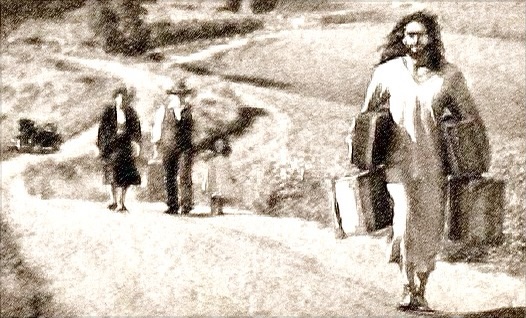
In a good life there is a careful foot. We are careful where we put each foot print
Proverbs 4:26–27
SOLOMON ADVISED A PLANNED WALK:
He wrote:
Ponder the path of your feet & let all your ways be established
SOLOMON ADVISED A PREFECT WALK:
Turn not to the right hand nor to the left
SOLOMON ADVISED A PROTECTED WALK:
Remove your foot from evil
There are some places to which we should not go
There are some doorways we should never darken.
Look at the steps of Abraham & Lot.
On that eventful day when Abraham suggested to Lot that they part company because of the squabbling of their herdsmen over available pasture
both men made a choice.
Genesis 13 records their decisions:
Lot … pitched his tent Gen. 13:12
Abram removed his tent” Gen. 13:18
There in a nutshell is the difference between Abraham (who became the friend of God & the father of all believers)
and Lot (the great Old Testament prototype of the backslider).
Lot’s feet took him pell-mell down to Sodom, where he lost family, faith & his fortune
He almost lost his soul.
Abraham’s feet took him over the hills & far away. He couldn’t wait to put distance between himself & the filthy city of the plains.
No one could be in that part of the world for any length of time & not know of the compromised moral depravity of Sodom’s reputation as the capital of decadent debauchery in the world.
Abraham didn’t want to be around when God poured out the red-hot lava of His wrath against that vile lifestyle. We all need to be careful where we place our feet.
Between 250 and 270 A.D. a terrible plague, believed to be measles or smallpox, devastated the Roman Empire. At the height of what came to be known as the Plague of Cyprian, after the bishop St. Cyprian who chronicled what was happening, 5,000 people died every day in Rome alone.
The plague coincided with the first empire-wide persecution of Believers under the emperor Decius. Not surprisingly, Decius & other enemies of the Church blamed Jesus followers for the plague. That claim was, however, undermined by two inconvenient facts: Christians died from the plague like everybody else & unlike everybody else, they cared for the victims of the plague, including their pagan neighbors.
This wasn’t new—Christians had done the same thing during the Antonine Plague a century earlier. As Rodney Stark wrote in “The Rise of Christianity,” Christians stayed in the afflicted cities when pagan leaders, including physicians, fled.
Candida Moss, a professor of New Testament and Early Christianity at Notre Dame, notes that an “epidemic that seemed like the end of the world actually promoted the spread of Christianity.” By their actions in the face of possible death, Christians showed their neighbors that “Christianity is worth dying for.”
This witness came to mind after listening to a recent story on National Public Radio’s “All Things Considered.” Host Robert Siegel interviewed Stephen Rowden, who volunteered for Doctors Without Borders in Monrovia, Liberia.
Rowden’s grim task was to manage the teams that collected the bodies of Ebola victims. Rowden & his team retrieved 10-to-25 bodies a day. Since close contact with the victims is the chief means by which the usually-deadly virus is spread, Rowden & his team members lived with the risk of becoming victims themselves.
What’s more, living in the midst of this death & suffering took its toll. Rowden recalled entering a house and finding the body of a four-year-old victim who had been abandoned by her family. With the typical English understatement, he told Siegel, “I found that a very sad case.”
Rowden’s experience prompted Siegel to ask him if he was a religious man, to which Rowden replied, “I am. Yes, I’m a practicing Christian.” When Siegel then asked whether what he saw tested his faith, Rowden said that “No, I got great strength from my faith & the support of my family.”
Nearly eighteen centuries after the Plague of Cyprian, Christianity still prompts people to run towards the plague when virtually everyone else is running away.
Now as then, this power confounds & confuses Christianity’s critics. A recent article in Slate acknowledged that many of the people fighting the Ebola epidemic in West Africa were missionaries.
The writer, Brian Palmer, admitted that he “[didn’t] feel good about missionary medicine, even though [he couldn’t] fully articulate why.” He knew that he shouldn’t feel this way but he did.
Ross Douthat of the New York Times suspects that Palmer’s misgivings have something to do with the fact that the selflessness of the missionaries “unsettles” his “secular and scientistic worldview.” In that worldview, “helping people is what governments & secular groups are supposed to do.”
But that’s not how it works. Palmer, like the emperor Julian the Apostate in the late fourth century, is seeing that “the impious Galilaeans support not only their own poor but ours as well.”









 Stevemidkiff's Blog